Grieving an Unknown Loss

Should We Own It?

Featured

Name It and Claim It: Just because it has a name, can we own it? Should we own it?

I want to talk about when we claim things in our lives as if they are a possession. Whether it is tangible or emotional or spiritual, how much of it do we grab a hold of and declare, “This is mine?”

This isn’t an exhaustive, philosophical paper on the prosperity gospel so don’t get excited. No, this is to provoke thought about ownership of the actions, thoughts, and emotions that are already part of our lives. Does owning something alter its value, whether it be real or perceived?

Let’s just make a list of the common tangible things that people own. These are the things that we can purchase or in other physical or legal ways, can very much claim to be “mine.”  My house. My car. My chair. Those are very basic possessions but still very much the kinds of things we own. What about things that are already of a part of us like our hair, eyes, etc.? Although not purchased they are inherently ours. Our family, our children our friends: people are obviously not things to be owned but we claim the position they hold in our lives and hearts.

A common quote, although likely inaccurate, is

Possession is nine-tenths of the law.

Meaning that when you physically possess something, you have a stronger legal claim to it than someone who just claims ownership. For example, you bought the hammer but I’m holding it, therefore it’s more mine than yours. Are you beginning to get the idea of that laying claim to something becomes how we believe it to be truly our own?

Let’s get a little more abstract because I want to explore the question, just because I claim this thing to be mine, do I own it? More importantly, should I own it? Let’s start by tackling the idea of owning an experience. Both good and bad things happen to us throughout life. Everything from experiencing the joy of watching a beautiful sunset to being abandoned as a child. That is the broadest stroke of the simplest good thing to one of the worst possible experiences ever. But are they ours? Can we claim the sunset as belonging to us? More to the point, is being abandoned ours to own? If we cannot own one experience, then we certainly cannot claim the other. These are events and happenings that may have had an impact on our lives in one way or another, but they are not ours to carry throughout our entire lives. Why would anyone ever want to own and haul around horrible experiences wherever they go? If you’ve ever moved from one house to another, then you know how very difficult it is to pack up and take everything you own. Everything gets scrutinized, carefully packed in tidy boxes, hauled away and then unpacked in the new location and re-displayed in the perfect new spot even though it’s still old stuff. Moving stuff can be heavy and awkward, and it almost always requires help, not to mention paying people in pizza.

If you’ve had an experience that was an offense was made against you, then yes, it is part of what has shaped you. But it is not yours to hold on to and pack up to make sure it’s aways with you, wherever you move to. Every time you claim ownership of it, you have essentially made it a part of your identity, just like your hair or eyes. But it isn’t yours. It happened to you. 

What about an illness or chronic condition? These are not the kinds of things that we can just decide they don’t exist.  They don’t always have a start and stop date but are seemingly ever present. Although just because it has a name, that doesn’t imply that we can own it. Arthritis, Diabetes, Cancer, OCD, Bipolar Disorder; they all have names, but did we purchase it? Can we sell it or trade it or even toss it aside and forget about it? None of these things have value like a treasured possession, whether it be monetary or sentimental. Nobody wants these things so why are we so ready to claim them just because they have a name, and own them as if we chose them like something we intentionally purchased?

When we refer to the things in our lives that we were never intended to own, as “mine” we make it part of our identity in the way that our hair, eye color, or the way we laugh are ours.

We often hear people talk about my anxiety, my disability, my depression, or my abuse, for examples. By denying them doesn’t make them go away. That’s a very ostrich-like approach. If we stick our head in the sand it doesn’t cease to exist. We once had a cat that would play hide and seek by sticking his head behind the curtain as if to say, “If I can’t see you then you can’t see me.” 

Not claiming ownership of something does not make it disappear. Rather, by not identifying these things as ours, as if they belong to us in the same way that our hair or eyes do, we remove them from being our identity.

When the things that we were not created to own become a part of our lives it is then that they becomes part of what influences us. There is no way these very difficult conditions cannot have an impact on our lives! They may create a physical limitation or cause us to look differently at circumstances. Some things may require special compensations or careful navigation to function well daily. 

The thing is:  just because it has a name, doesn’t mean we have to claim it. It certainly does not mean we should own it. 

Peace that Passes Understanding

Featured

There are so many quips and quotes that are meant to encourage us to be better people. A part of society (and I hope a large part) are earnestly trying to serve their fellow-human. The very basic idea of making servanthood our purpose is so Biblically based that even good people who don’t profess to be Christian, can’t deny that God said it first.

When asked what is the greatest commandment? “Jesus replied: “‘Love the Lord your God with all your heart and with all your soul and with all your mind.38 This is the first and greatest commandment. 39 And the second is like it: ‘Love your neighbor as yourself.” ~ Matthew 22:37-39

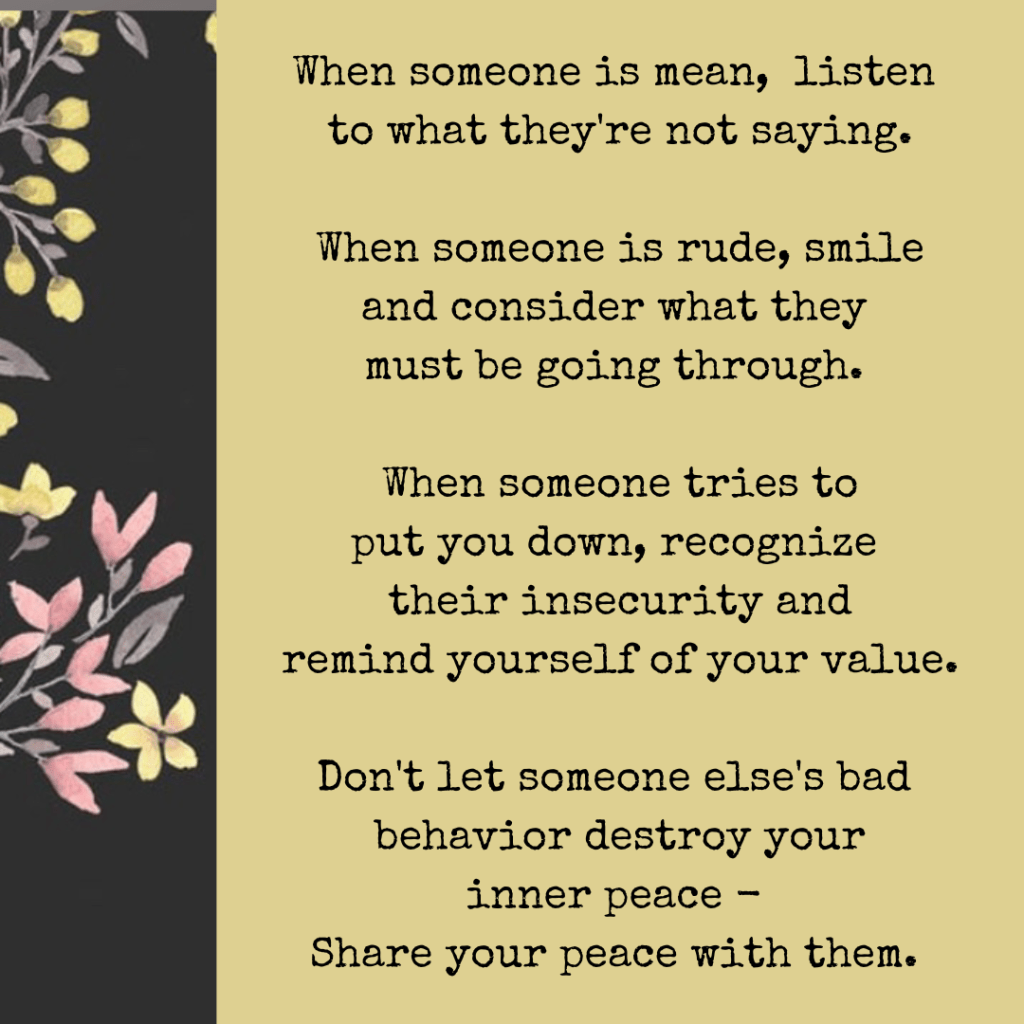
The book of Matthew has great instruction for interacting with fellow humankind, even those who treat us badly. In chapter 5, versus 43-48 we are even told to love our enemies! There is so much wrong with self-preservation thinking because it is the opposite of what Jesus taught. For example, this is one of those social media posts making the rounds that have taken a hold of people’s thinking – so much so that even Christians begin to speak these kinds of things.

Believers! what ever happened to Turn the other cheek; Forgive seventy times seven; Live humbly, Allowing God to be your Protector, and Above all things – Love, show Mercy and Forgiveness, and be Gracious?

We have been given such a gift of inner peace and other people need it so badly. No thing or no person’s behavior can destroy that. Our mission is to share His peace, putting into practice the ways that Jesus taught us.

In this world, all people have hurts and hang-ups. As Christians however, we know where our peace comes from. We can become ineffective as Christians if we become closed off to the world that we are called to serve. If we fall into the trap of the practices of self-preservation that society promotes, we risk being as empty and lost as those who behave in the way we were trying to protect ourselves from..

Let’s change the message and allow Jesus to protect our hearts while we practice sharing the only kind of inner peace that will satisfy every troubled heart.

“I have told you these things, so that in me you may have peace. In this world you will have trouble. But take heart! I have overcome the world.” – John 16:33

Thoughts of Security

Featured

We all know what insecurities are or at least we know the general gist of what it means to feel insecure by today’s world of self-awareness. To be emotionally insecure by definition, is to lack confidence, assurance, or to have self-doubt. And that is enough all by itself but the layers of severity or areas of insecurity have become extensive in the minds of people today.

What if we viewed insecure as the opposite of secure? Most definitions of the word Secure don’t even mention emotions or behavior. Secure: dependable, firm, to be trusted, to obtain, free from danger. If our insecurities are rooted in our emotions or thoughts, why would we give weight to something that is Undependable, soft, NOT to be trusted, or dangerous?

When a steam kettle is left on the stove, it will whistle and make all kinds of noise when it reaches the boiling point. That’s your first warning. Left unattended, it may boil over and make a huge mess and eventually it will go dry, leaving the kettle to burn and possibly causing a room full of smoke and maybe even fire. That is the same with thoughts and imaginations that are stemmed in insecurity. A thought may come to mind that is based on a personal emotional insecurity – by the definition above that would be a thought based on “lack of confidence or self-doubt.” It’s when we let it heat up to a boil that it becomes the kind of insecurity that is the opposite of secure: undependable and dangerous.

So how do we nip those thoughts that are based on self doubt, in the bud before they come to boiling point? the Bible tells us this about our thoughts in Philippians 4:8.(MSG)

Summing it all up, friends, I’d say you’ll do best by filling your minds and meditating on things true, noble, reputable, authentic, compelling, gracious—the best, not the worst; the beautiful, not the ugly; things to praise, not things to curse.

Beside the Quiet Water

Featured

I can only imagine what chaos life would be if I were being tossed around by the storms that surround me. Somehow I am able to lay beside the quiet water. It’s not like I’m in charge of any of the storms or have any control over them anyway. It’s still true that they are certainly out there, except they have no impact on me and I have no control over them.

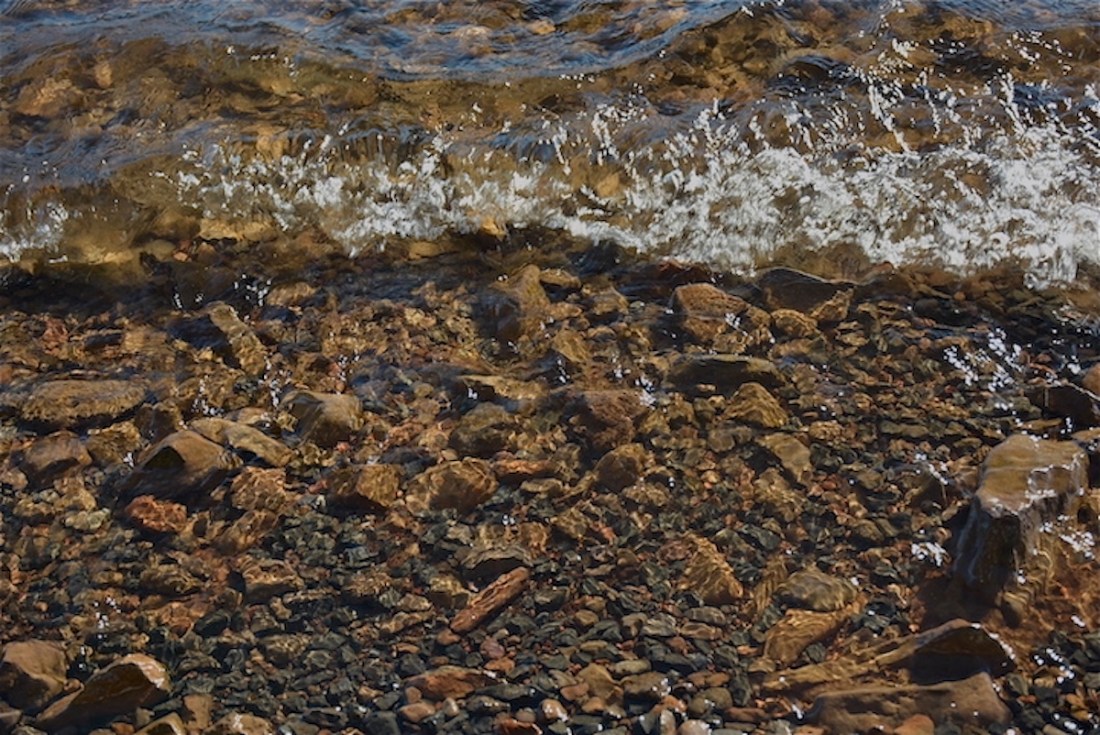
I see myself laying on the edge of a large, mountain lake where I can feel the wind blow over me while the gentle ebb and flow the water splash against me where I lay. The sight is almost hypnotizing in its rhythm, back and forth across the pebbles. The wind through the pines are the perfect level of sound like the best background music I could have ever chosen. However, if I sit up a little and look out across the lake where it meets the horizon, I can see the water is rough out there. Little white caps from the waves kicking up and folding over themselves are a little disorienting because it is in contrast to the water here on the edge, where the water just trickles gently back and forth. The wind is doing more out there than making sweet music in the trees. If I strain, I can hear how it makes the water create it’s own noise in the splashing. The sky looks a little dark, too, as if it is a completely different sky from the one I’m laying under at the shoreline.

The thing is, I know that the storm is out there. It might be coming my direction or it might just blow on past. From where I lay beside the quiet water, that storm is out of my reach and beyond my control. So I lay back down and let that distant storm play itself out while I lay beside these quiet waters.

“The Lord is my Shepherd. I shall not want. He makes me lie down in green pastures, he leads me beside quiet waters. He restores my soul.”